| Course
Title |
: CISSP
Exam Preparation Workshop |
Course
Duration
|
: 6 Day
Online Instructor Led Workshop
: Online
workshop is delivered in two days, two units
each day between 9:00 am to 1 pm and 3 pm to
6:00 pm |
| Course Fee |
: Available
upon request
|
| Course
Location |
: TLC
(Karachi), Customer Onsite, and Online |
|
: Online
workshop are delivered in six days, two units
each day between 11 am to 1 pm and 3 pm to 5
pm |
| Course Code |
: TN229 |
| Deliverables |
:
Comprehensive Student Guide and Workshop
Certificate |
Customer onsite
workshop can also be conducted for customers in
Lahore, and Islamabad
About
CISSP
The CISSP training course provides
delegates with a theory-based approach to learning
the security process. The course is centered
around teaching the fundamental domains of
Information Security. These eight domains provide
delegates with all the information they require to
obtain a comprehensive understanding of
Information Security and pass the CISSP exam.
Despite being a theory-based course, the CISSP
certification trains individuals to practically
apply what they have learn. This CISSP course
gives delegates skills which are desirable in any
company, and so this qualification can help
individuals stand out in a competitive
market.
This workshop is designed for this
purpose, as well as to provide the insight into
the importance of cybersecurity risk management
framework covering 8 comprehensive security
domains.
For becoming a CISSP certified, you must
have a minimum of five-year cumulative paid work
experience in two or more of the eight domains of
the CISSP.
TARGETED
AUDIENCE
Business,
application, audit, risk, compliance, infoSec and
CyberSec Professionals, project managers, IT
operations, Enterprise Architectures, and legal
professionals with a familiarity of basic IT/IS
concepts.
Within any
organization, system security is crucial, and it is
becoming clear that organizations require better
means to combat malicious cyber-attacks, as they
increasingly become more and more advanced and
difficult to manage. As such, businesses require
trained staff who have an up-to-date understanding
of the latest threats to information system
security.
CISSP
Certification Benefits
A CISSP
certification is exceedingly credible and an
enviable addition to your CV. This is because this
highly regarded credential is exactly what
organizations look for when searching for an
Information Security Professional. Therefore, CISSP
certification holders can benefit from:
- Great job
prospects - CISSP is the most prestigious
Information Systems Security certification and
will help you stand out in a competitive market of
IT Security Professionals. CISSP Professionals
have deep technical knowledge and skill.
- A CISSP
certification is often asked for in job
descriptions - it is considered a basic
requirement because CISSP training covers all that
is required to prepare security professionals to
address any security threat.
- Demonstrate
that you are committed to Information Security.
- All
organizations have IT systems and so Information
System Security Professionals are constantly in
demand and there are a number of job opportunities
available.
- Enter into a
career that is considered to be one of the most
stable in the IT industry.
Workshop
Methodology
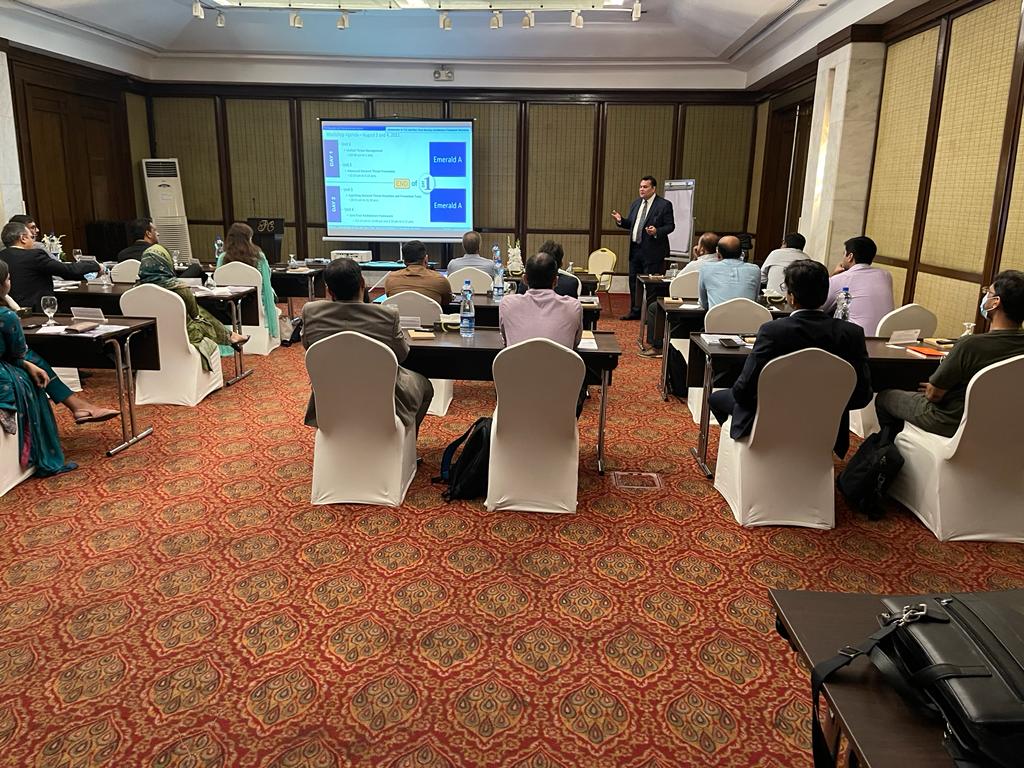
The training course
flow will be a mix of lectures & classroom
discussions and videos so that participants can have a
detailed understanding of various components and
technologies discussed in 8 domains.
ABOUT THE
INSTRUCTOR
This workshop shall
be delivered by TOGAF 9 Certified/IBM Certified
Infrastructure System Architect and an experienced
trainer with 30+ years of career experience
imparting education and training services both
locally and internationally and have worked for
international enterprise technology vendors
including IBM, Fujitsu, and ICL. Our instructor
holds various industry professional certifications
in the space of enterprise servers and storage
technologies, Information Security, Enterprise
Architecture, ITIL, Cloud Computing, Blockchain
Technology Virtualization, Green IT, and a co-author
of 10 IBM Redbooks.
COURSE
OUTLINE
Domain
1 – Security and Risk Management
- 1.1:
Understand and apply concepts of
confidentiality, integrity and
availability.
- 1.2:
Evaluate and apply security governance
principles.
- 1.3:
Determine compliance requirements.
- 1.4:
Understand legal and regulatory issues
that pertain to information security in
a global context.
- 1.5:
Understand, adhere to, and promote
professional ethics.
- 1.6:
Develop, document, and implement
security policy, standards, procedures
and guidelines.
- 1.7:
Identify, analyze, and prioritize
Business Continuity requirements
- 1.8:
Contribute to and enforce personnel
security policies and procedures.
- 1.9:
Understand and apply risk management
concept.
- 1.10:
Understand and apply threat modeling
concepts and methodologies.
- 1.11:
Apply risk-based management concepts to
the supply chain.
- 1.12:
Establish and maintain a security
awareness, education, and training
program.
Domain 2
– Asset Security
- 2.1:
Identify and classify information and
assets.
- 2.2:
Determine and maintain information &
asset ownership.
- 2.3:
Protect privacy.
- 2.4:
Ensure appropriate asset retention.
- 2.5:
Determine data security controls.
- 2.6:
Establish information and asset handling
requirements.
Domain 3
– Security Architecture and
Engineering
- 3.1:
Implement and manage engineering
processes using secure design
principles.
- 3.2:
Understand the fundamental concepts of
security models.
- 3.3:
Select control based upon systems
security requirements.
- 3.4:
Understand the security capabilities of
information systems.
- 3.5:
Assess and mitigate the vulnerabilities
of security architectures, design and
solution elements.
- 3.6:
Access and mitigate vulnerabilities in
web-based systems.
- 3.6:
Access and mitigate vulnerabilities in
web-based systems.
- 3.7:
Assess and mitigate vulnerabilities in
mobile systems.
- 3.8:
Assess and mitigate vulnerabilities in
embedded devices.
- 3.9:
Apply cryptography.
- 3.10:
Apply security principles to site and
facility design.
- 3.11:
Implement site and facility security
controls.
Domain 4
- Communication and Network Security
- 4.1:
Implement secure design principles in
network architecture.
- 4.2:
Secure network components.
- 4.3:
Implement secure communication channels
according to design.

|
Domain
5 - Identity and Access Management (IAM)
- 5.1:
Control physical and logical access to
assets.
- 5.2:
Manage identification and authentication
of people, devices and services.
- 5.3:
Integrate identity as a third-party
service.
- 5.4:
Implement and manage authorization
mechanisms.
- 5.5:
Manage the identity and access
provisioning life-cycle.
Domain 6
- Security Assessment and Testing
- 6.1:
Design and validate assessment, test and
audit strategies.
- 6.2:
Conduct security control testing.
- 6.3:
Collect security process data.
- 6.4:
Analyze test output and generate
reports.
- 6.5:
Conduct and facilitate security audits.
Domain 7
– Security Operations
- 7.1:
Understand and support investigations.
- 7.2:
Understand the requirements for
different types of investigations.
- 7.3:
Conduct logging and monitoring
activities.
- 7.4:
Securely provision resources.
- 7.5:
Understand and apply foundational
security operations concepts.
- 7.6:
Apply resource protection techniques.
- 7.7:
Conduct incident management.
- 7.8:
Operate and maintain detective and
preventative measure.
- 7.9:
Implement and support patch and
vulnerability management.
- 7.10:
Understand and participate in change
management processes.
- 7.11:
Implement recovery strategies.
- 7.12:
Implement disaster recovery processes.
- 7.13:
Test disaster recovery plans – DRP.
- 7.14:
Participate in business continuity
planning and exercises.
- 7.15:
Implement and manage physical security.
- 7.16:
Address personal safety and security
concerns.
Domain 8
- Software Development Security
- 8.1:
Understand and apply security in the
software development lifecycle.
- 8.2:
Enforce security controls in development
environments.
- 8.3:
Assess the effectiveness of software
security.
- 8.4:
Assess security impact of acquired
software.
- 8.5:
Define and apply secure coding
guidelines and standards.
|

|



















 List
of
IBM AIX Operating System
List
of
IBM AIX Operating System